- Have any question(s)?
- editor@inecnews.com


Ekiti Election
June 25, 2026New Dawn: Amupitan and the Task of Rebuilding Electoral Trust
Sworn in amid rising expectations, Prof. Joash Ojo Amupitan, SAN, began his tenure as Chairman of the Independent National Electoral Commission (INEC) with a firm message: electoral integrity is non-negotiable. From internal discipline and zero tolerance for misconduct to technology, staff welfare, and institutional reform, DAYO OKETOLA examines the early signals of the Amupitan era and what they mean for the future of INEC.
At exactly 1:50 p.m., inside the Council Chamber of the Presidential Villa, Abuja, Prof. Joash Ojo Amupitan, SAN, raised his right hand and took the oath of office as Chairman of the Independent National Electoral Commission (INEC) on Thursday, October 23, 2025. With that moment, Nigeria’s electoral umpire entered a new chapter shaped by high expectations, institutional memory, and an unmistakable demand for integrity.
President Bola Ahmed Tinubu, GCFR, who administered the oath, did not mince words. The President charged the new Chairman to protect the integrity of Nigeria’s elections and strengthen the institutional capacity of INEC. President Tinubu described Amupitan’s appointment —which was earlier confirmed by the Senate after a rigorous screening—as a reflection of the confidence reposed in his character, intellect, and professional standing.
“Our democracy has come a long way,” the President observed. “But to maintain public trust, electoral integrity must be protected. All aspects of the process, from registration to voting and counting, must be transparent, non-violent, and credible.”
Those words did not merely frame a ceremonial transition. They echoed a philosophy that Prof. Amupitan had already begun articulating—one that would soon crystallize into what many within the Commission have come to describe as a defining feature of his leadership, which is zero tolerance for compromise on electoral integrity.
Since his appointment and swearing-in, Prof. Amupitan has left no ambiguity about the foundation of his tenure. In his earliest engagements, particularly his inaugural meeting with the INEC management, he made it clear that electoral integrity is neither a slogan nor a reactive posture adopted under pressure. It is, in his words, “a moral and legal duty owed to every Nigerian citizen.”
This framing is significant. It elevates the Commission’s work beyond administration and procedure, placing it squarely within the realm of public trust. For Amupitan, INEC is not merely an Election Management Body; it is the custodian of the people’s sovereign will. And that custodianship begins not with political actors outside the Commission, but within INEC itself.
The message to staff (over 14,000 permanent employees) has been consistent and unmistakable. According to Amupitan, the credibility of Nigeria’s democracy begins and ends with the conduct of INEC officials.
In several early speeches, the Chairman’s tone balanced inspiration with firmness. He has spoken of service, patriotism, and the honour of contributing to national development. But he has also issued stern warnings that any compromise on values, procedures, or standards will not be tolerated.
This uncompromising stance has come to be seen internally as the core of what might be described as the ‘Amupitan Doctrine’, a proactive leadership philosophy designed to prevent electoral malpractice by clearly defining expectations and consequences.
Under this doctrine, both errors of omission and commission are treated with equal seriousness. Failure to follow established procedures, just as much as deliberate manipulation, is viewed as a threat to public trust. For an institution that has, over the years, struggled against perceptions of internal vulnerability and external interference, this clarity represents a decisive shift. The aim is to seal the systemic cracks through which electoral malpractices (such as rigging, result manipulation, or logistical sabotage) have historically found entry.
Prof. Amupitan has been equally firm on the importance of deploying electoral technology. He has repeatedly stressed that the Bimodal Voter Accreditation System (BVAS) and the INEC Result Viewing Portal (IReV) are not optional innovations; they are legal imperatives grounded in the Electoral Act, 2026. Deviation from their prescribed use, no matter how minor, undermines public confidence and opens space for doubt, speculation, and litigation. Under Amupitan’s leadership, fidelity to technology is framed as fidelity to the law itself.
Yet the Chairman has also demonstrated a nuanced understanding of the limits of technology. Tools alone cannot guarantee credibility if the human element falters. This is why his emphasis on internal discipline runs parallel to a renewed focus on training, supervision, and accountability.
One of the more striking features of Prof. Amupitan’s early engagements has been his insistence that operational failure is an integrity failure. In discussing preparations for elections, he has repeatedly underscored the importance of logistics, not as a technical afterthought, but as a moral obligation. His belief is that elections fail not only when ballots are manipulated, but when logistics collapse. Timely deployment, adequate training, and transparent communication around operations are now treated as essential components of electoral credibility.
President Tinubu, in his swearing-in remarks, spoke of strengthening electoral institutions to make them robust and resilient. Prof. Amupitan’s response to that charge has been to focus on positive outcomes such as peaceful elections, credible results, and growing public trust. The off-cycle elections will serve as the ultimate test for the 2027 General Elections, according to him.
Nigeria’s democracy, as the President observed, has made progress, but it remains a work in progress. The task before the new INEC Chairman is formidable: to consolidate reforms, deepen trust, and insulate the electoral process from both human frailty and political pressure.
As he left the Council Chamber on the day of his swearing-in, dressed in a flowing agbada and gold cap, exchanging greetings with well-wishers, Prof. Amupitan carried with him the weight of history and expectation while heading to the INEC Headquarters in Abuja.
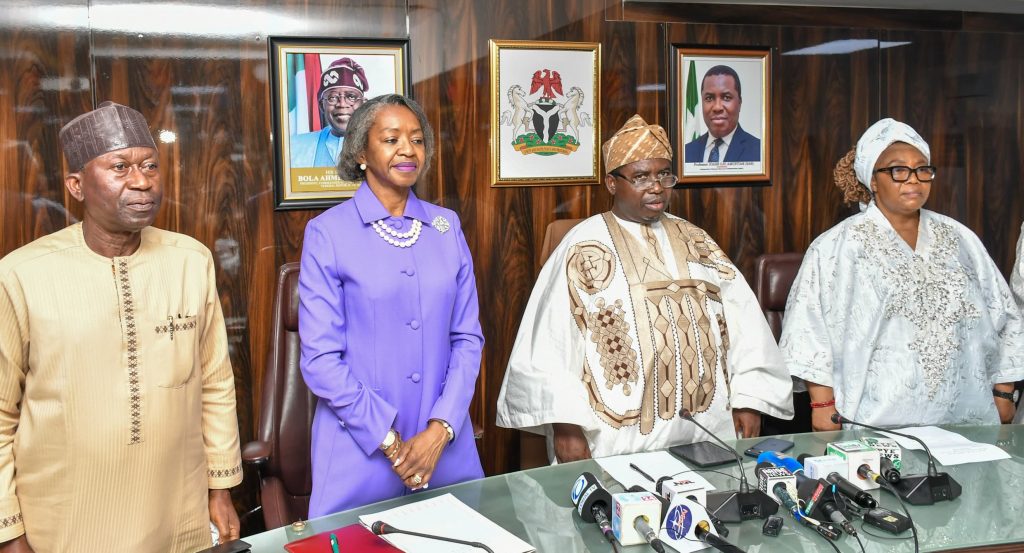
Speaking at the Commission’s Headquarters shortly after formally assuming office, the new INEC helmsman described his appointment as “a divine call to national service” and emphasized that the credibility of elections is not up for negotiation.
“Our mandate is clear: to deliver free, fair, and credible elections that reflect the will of the Nigerian people,” Prof. Amupitan declared. “To achieve this, we must work together as a team, leveraging our individual expertise and collective experience. The integrity of our elections is not something we should even negotiate. It is the soul of democracy.”
The new Chairman, who was accompanied by senior officials of the University of Jos, including the Vice-Chancellor, Professor Tanko Ishaya, expressed deep appreciation to President Tinubu for entrusting him with what he described as “a herculean but noble national assignment.” He noted that while the expectations of Nigerians were high, he was confident that with the cooperation and dedication of INEC staff nationwide, the Commission would deliver on its constitutional mandate.
Prof. Amupitan assured staff that their welfare would be given top priority under his leadership, describing them as “the engine room of the Commission.”
“We are going to be expecting so much from you,” he said, “and it is only fair that we also give so much to those from whom we expect much. Your welfare will be a priority. We will ensure that your working conditions are conducive and that you have the resources to excel.”
He urged staff to close ranks, break down silos, and maintain synergy across departments, noting that unity and collaboration would be essential for the Commission’s success.
“Let’s restore the confidence of every voter that their vote counts,” he emphasized. “We must end voter apathy and rebuild trust in the process.”
Significantly, the Chairman has continued to match his call for discipline with an equally strong emphasis on staff welfare. In multiple engagements, he has reassured personnel that the Commission would prioritize conducive working conditions and provide the resources necessary for excellence.
Prof. Amupitan understands that integrity cannot thrive in an environment of neglect. A motivated, protected, and well-trained workforce is the most effective defense against external pressure and internal compromise.
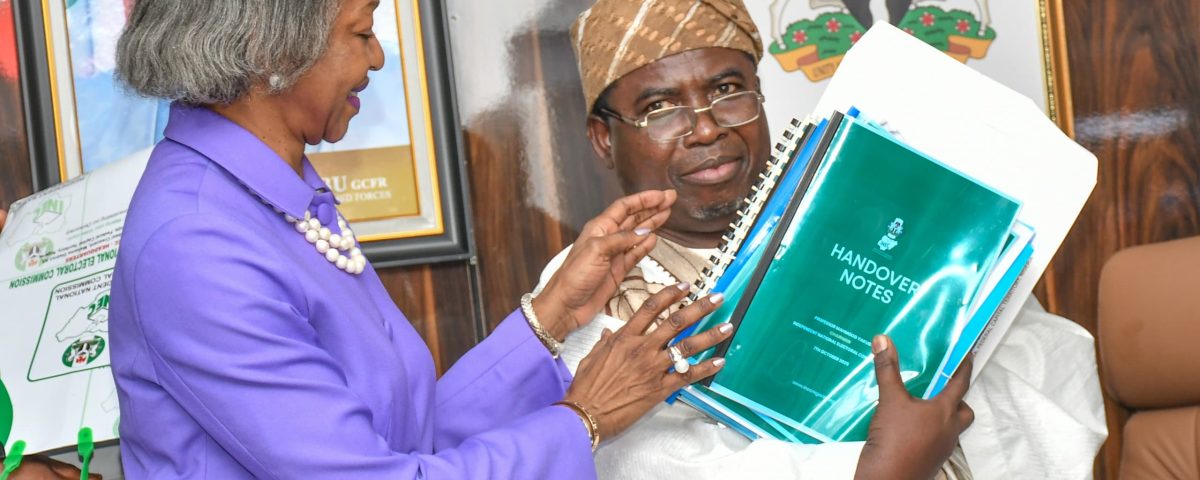
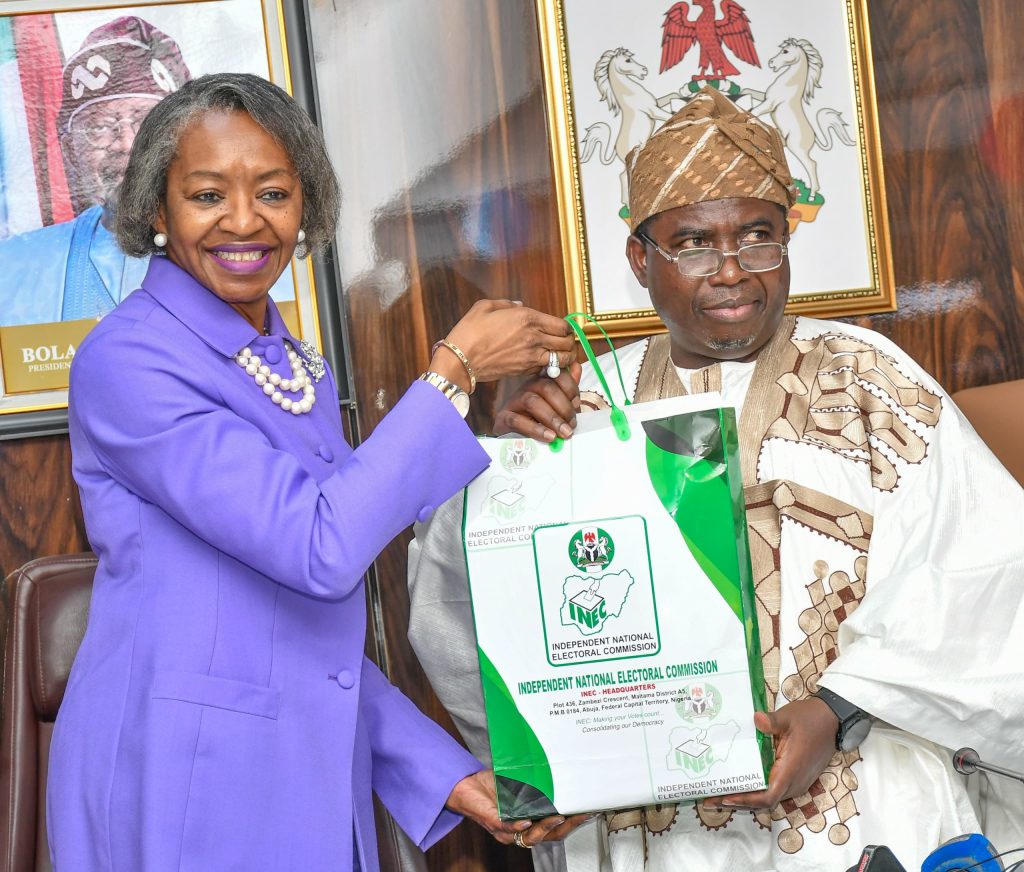
Earlier, in a brief but heartfelt handover remark, the then-Acting Chairman, Mrs. May Agbamuche-Mbu, congratulated Prof. Amupitan on his appointment and assured him of the full support of the Commission’s staff. Describing the day as “a moment of continuity and renewal,” she lauded Prof. Amupitan’s distinguished record and expressed confidence that his tenure would build upon the strong institutional foundation laid by his predecessor, Prof. Mahmood Yakubu.
“You are not walking into an empty field,” Mrs. Agbamuche-Mbu said. “The Commission has been blessed with a team of dedicated and patriotic staff who will stand firmly with you as you lead INEC into its next chapter.”
While presenting the official handover notes, Mrs. Agbamuche-Mbu commended the dedication and professionalism of INEC staff across the country and expressed optimism that under Prof. Amupitan’s leadership, the Commission would “soar to greater heights and further strengthen the foundation of Nigeria’s democracy.”
The brief but symbolic ceremony was attended by the wife and children of the INEC Chairman, National Commissioners, the Secretary to the Commission, Directors, senior officials, members of the INEC Press Corps, and other family members of the new Chairman.
By linking high standards with institutional support, Prof. Amupitan—the sixth substantive Chairman of INEC since Nigeria’s return to democratic rule in 1999—has signaled a leadership style rooted in fairness and mutual responsibility.